
What is a good keyword difficulty? For a brand-new blog, it’s 0–10 in Ahrefs or 0–14 in Semrush. Both tools put these scores in their easiest tier, where a new page can reach page one without many backlinks. Once your site has a few months of content and some links, you can move up to around 20.
Most guides stop at that number. This one goes further. You’ll see what each KD score means in actual backlinks, how to work out the highest KD your site can handle, and two real keywords I checked today, one I rejected and one I chose. If you’re still setting up your blog, read how to start a blog with no money first, then come back here before you write your first post.
Key takeaways
- New blogs should target KD 0–10 (Ahrefs) or 0–14% (Semrush).
- In Ahrefs, KD 10 means you need links from roughly 10 websites to reach the top 10. KD 30 needs about 36.
- Your real limit depends on how many links your pages can earn, not on a universal number.
- KD ignores content quality and search intent. Always check the results page before you write.
- A low score is only useful if people search the keyword and actually click through.
What keyword difficulty measures (and what it ignores)
Keyword difficulty (KD) is a 0–100 score from SEO tools that estimates how hard it is to reach Google’s top 10 for a keyword. It isn’t a Google metric. Each tool builds its own.
- Ahrefs bases KD on the number of referring domains (unique websites linking) to the top 10 organic results, according to its help center.
- Semrush combines the referring domains of ranking pages, their dofollow/nofollow ratio, the authority of the ranking sites, and features of the results page.
Two limits matter, and most articles skip them. First, Ahrefs states that its KD estimates your chances of reaching the top 10, not the top 3 or #1. Second, it says KD doesn’t take any on-page factors into account (Ahrefs). A low score can’t tell you whether the ranking pages are well written or whether your content matches what searchers want. You have to check that yourself.
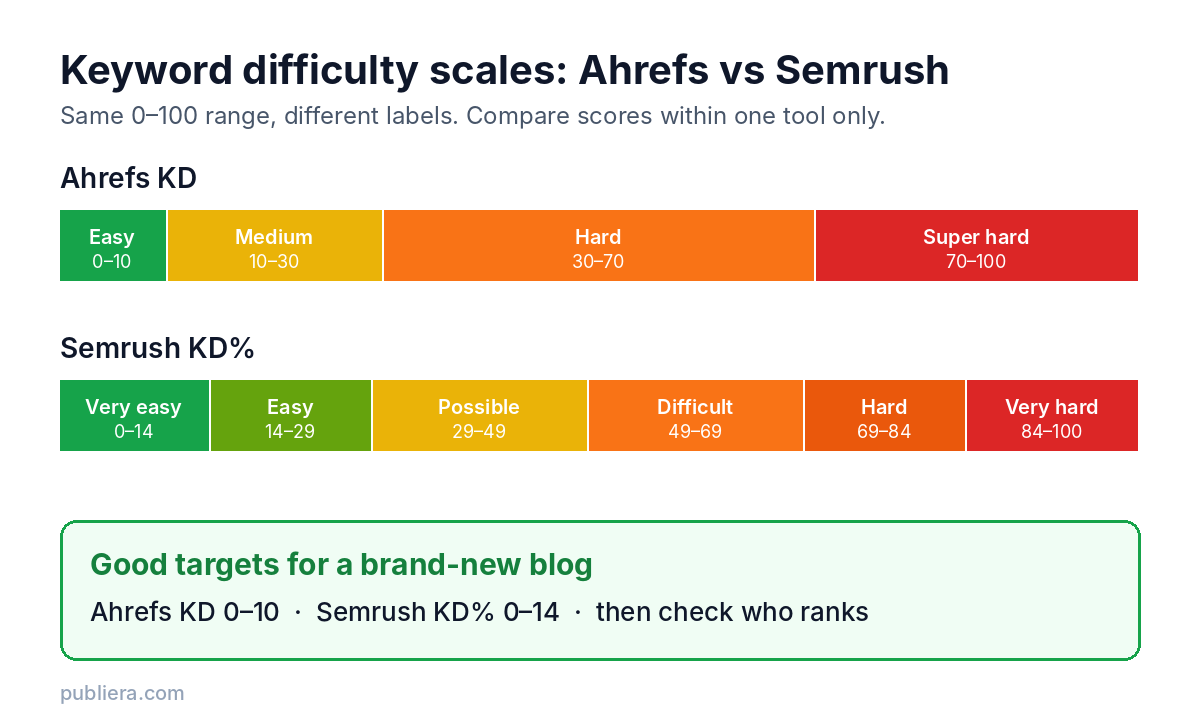
Keyword difficulty scales: Ahrefs vs Semrush
|
Ahrefs KD |
Ahrefs label |
Semrush KD% |
Semrush label |
|---|---|---|---|
|
0–10 |
Easy |
0–14 |
Very easy |
|
11–30 |
Medium |
15–29 |
Easy |
|
31–70 |
Hard |
30–49 |
Possible |
|
71–100 |
Super hard |
50–69 |
Difficult |
|
70–84 |
Hard | ||
|
85–100 |
Very hard |
Semrush lists its six levels in its knowledge base and calls the 0–14 tier the best opportunity for new pages. Because the scales differ, a KD of 25 is “Medium” in Ahrefs but “Easy” in Semrush. Pick one tool and compare keywords only within it.
What a KD score means in backlinks
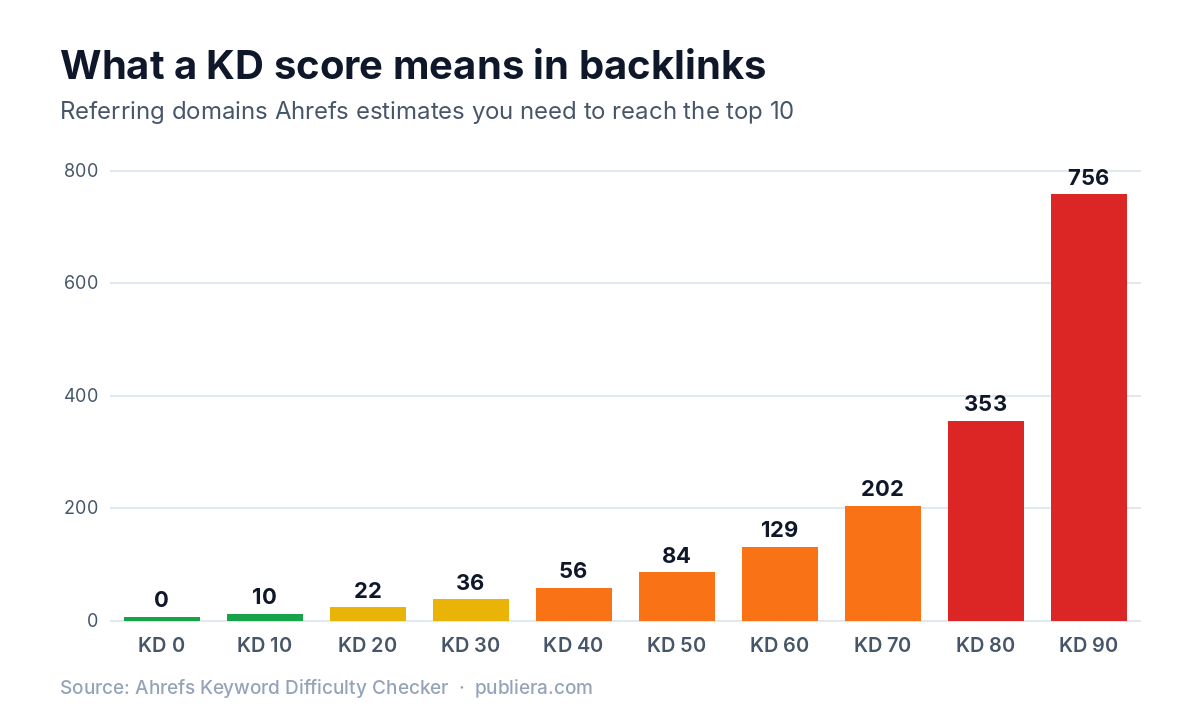
A score like “KD 28” is hard to act on. Ahrefs publishes how its scores translate into the number of linking websites you’d need to reach the top 10, which turns the score into a concrete target:
Source: Ahrefs Keyword Difficulty Checker
|
Ahrefs KD |
Referring domains needed (approx.) |
|---|---|
|
0 |
0 |
|
10 |
10 |
|
20 |
22 |
|
30 |
36 |
|
40 |
56 |
|
50 |
84 |
|
60 |
129 |
|
70 |
202 |
|
80 |
353 |
|
90 |
756 |
The curve isn’t straight. Going from KD 10 to 30 means about 3.6 times as many links, and from 30 to 60 about 3.6 times again. That’s why a new site should treat every few points of KD as a big jump in effort.
What Is a Good Keyword Difficulty for Your Blog?
This is the rule of thumb I use. It’s a starting point, not a law.
|
Your site |
Ahrefs KD to target |
Semrush KD% to target |
|---|---|---|
|
Brand new (0–3 months, few or no backlinks) |
0–10 |
0–14 |
|
Growing (some posts ranking, a handful of links) |
10–20 |
15–29 |
|
Established (steady traffic, links from relevant sites) |
20–30+ |
30–49+ |
Easy keywords get your first posts indexed and earning impressions. Each post that ranks makes the next, slightly harder keyword more realistic.
How to find your own KD limit in 10 minutes
A fixed number ignores the one thing that matters most: how many links your pages can realistically earn. Here’s how to set a personal ceiling:
- Find your best-linked post. Paste your domain into the free Ahrefs Backlink Checker and note how many referring domains your strongest page has.
- Be honest about the next 3 months. How many websites could you get to link to a new post through outreach, guest posts or journalist quotes? Write that number down.
- Match it to the table above. If you can earn links from about 10 sites, your ceiling is around KD 10. If you can reach about 20, aim for keywords up to roughly KD 18–20.
- Brand-new site with zero links? Your ceiling is KD 0–10. Your content has to do all the work.
Semrush offers a similar idea called Personal Keyword Difficulty, which scores a keyword against your specific domain. It’s a paid feature, so the manual method above is a good free substitute.
A real example: two keywords I checked today
I’m planning Publiera’s first month of posts, so I ran two keywords through the free Ahrefs keyword difficulty checker (United States).
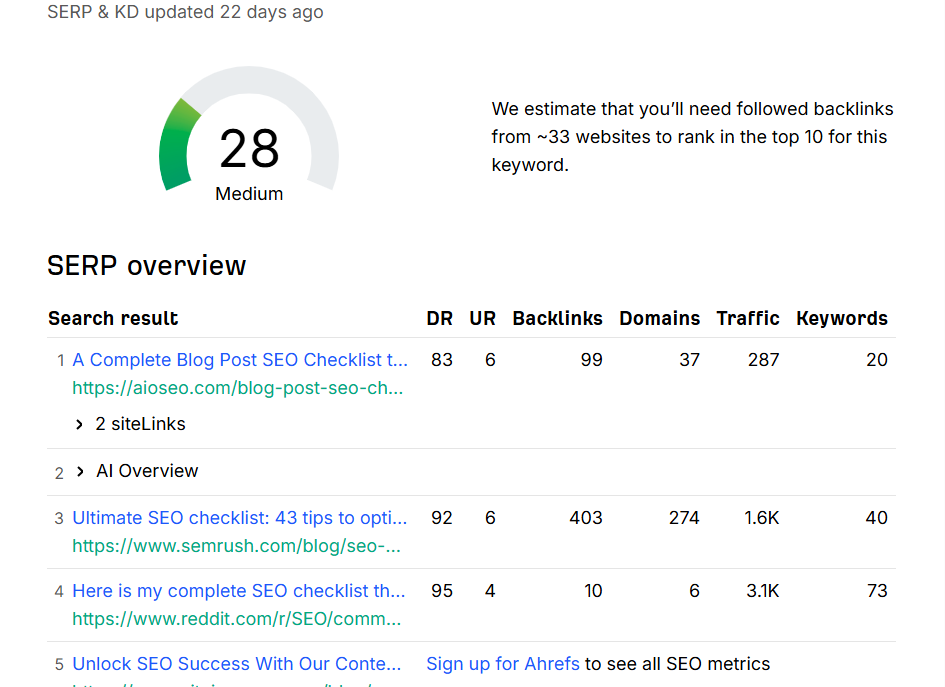
Keyword 1: “blog seo checklist” — KD 28 (Medium), rejected
Ahrefs result for “blog seo checklist” (US)
Ahrefs estimated I’d need followed backlinks from about 33 websites to reach the top 10. The top results were AIOSEO (DR 83) and Semrush (DR 92). With a new site and no links yet, that’s well above my ceiling.
One detail is worth noting: a Reddit thread ranked #4. When forum threads rank, the existing articles often don’t fully answer what searchers want. I’ve saved that keyword for later, once Publiera has links.
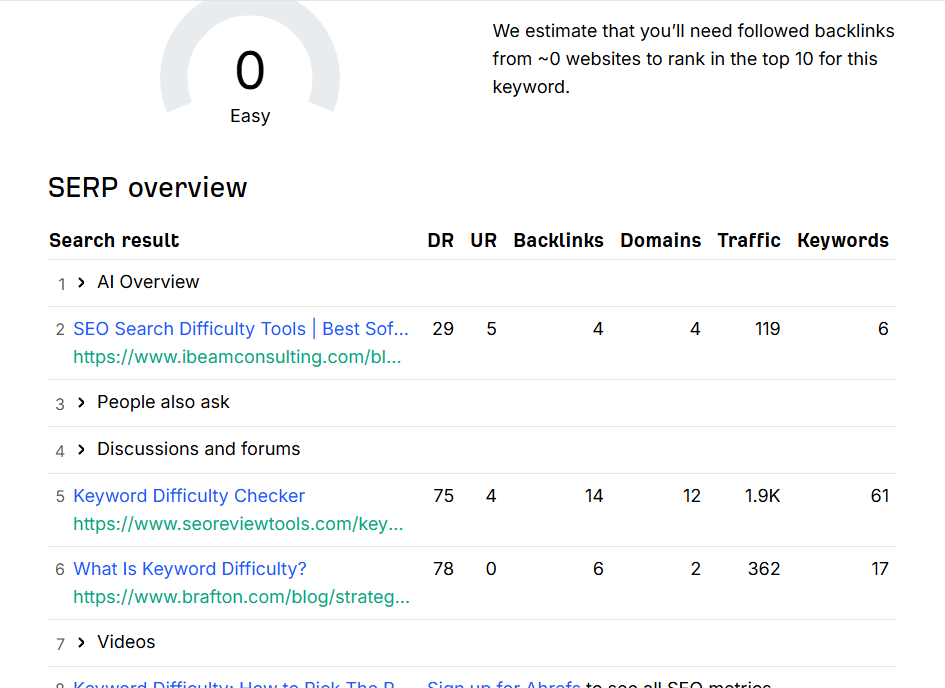
Keyword 2: “what is a good keyword difficulty” — KD 0 (Easy), chosen
Ahrefs result for “what is a good keyword difficulty” (US)
Ahrefs estimated about 0 linking websites needed. The results page confirmed it:
- A site with DR 29 ranked #2, with links from only 4 websites.
- Google showed a “Discussions and forums” block, a sign that searchers aren’t fully satisfied.
- A strong domain (DR 78) ranked with a page rated UR 0, meaning that specific page had almost no links.
That’s the article you’re reading. Same niche, same tool, two very different chances of ranking.
A low KD isn’t enough: 5 checks before you write
KD only looks at links. Before writing, search the keyword on Google and check these five things:
- Search demand. A KD 0 keyword nobody searches brings no traffic. Make sure the tool shows some volume, or that the phrase is a shorter version of something people clearly ask.
- Intent match. Are the top results guides, tools or product pages? If you’d write a guide but Google shows tools, change your angle or pick another keyword.
- Weak spots in the results. Forums, small sites (DR under 30) or big-site pages with almost no links (low UR) all mean a new page can compete.
- The top 3, not just the top 10. Since KD averages the whole first page, check the referring domains of the top 3 results. If #1 has hundreds of links, KD understates how hard the top spot is.
- AI Overviews. If Google fully answers the question at the top of the page, fewer people click. Small publishers have lost about 60% of Google referral traffic over two years as AI answers spread, according to Chartbeat data reported in March 2026 (Windows Report). Favor topics where readers need more than a two-line answer.
Free tools to check keyword difficulty
|
Tool |
What you get free |
Best for |
|---|---|---|
|
KD score, estimated links needed, top results with DR and referring domains |
Seeing exactly why a keyword is hard | |
|
KD% and search volume |
A second opinion using a different formula | |
|
Difficulty and competition for a keyword |
Quick checks on long-tail ideas |
What “No data” means
If a tool shows “No data”, it hasn’t recorded enough searches for that exact phrase. That’s common with very long questions and future-year terms like “2027” before people start searching them. Try a shorter version. That’s how I found this post’s keyword: the long question returned no data, and the shorter version returned KD 0.
What to do when a keyword is too hard
- Add a modifier: “for beginners”, “for new blogs”, “step by step”, “without plugins”.
- Narrow the audience or platform: “SEO checklist for WordPress beginners” instead of “SEO checklist”.
- Answer one sub-question: pick a question from Google’s “People also ask” box and write the best answer on the web.
- Save it for later: keep a list of harder keywords and come back once your site earns links.
Whatever you choose, write for readers first. Google says its ranking systems reward helpful, reliable, people-first content, and a low KD only gives you the chance to compete. Not sure what to write when you’re new? See how to start a blog without writing.
The bottom line
If your blog is new, target KD 0–10 in Ahrefs (or 0–14 in Semrush). Then work out your own ceiling from the links you can realistically earn, and confirm every keyword with a five-minute look at the results page. Publish consistently, let the easy posts get indexed, and move up as your site earns trust.
FAQ
Is a keyword difficulty of 30 good?
For an established site, yes. For a new blog it’s usually too hard: in Ahrefs, KD 30 means you’d need links from about 36 websites to reach the top 10. Start below 10 and work up.
What is a good keyword difficulty in Semrush?
For a new site, 0–14% (“Very easy”). Sites with some authority can target 15–29% (“Easy”).
Does keyword difficulty 0 mean I’ll rank #1?
No. KD estimates your chances of reaching the top 10, not #1, and it ignores content quality. You still need a page that answers the search better than what’s ranking now.
Why do Ahrefs and Semrush show different scores?
They use different formulas. Ahrefs relies on links to the ranking pages; Semrush also weighs site authority, link types and features of the results page. Compare keywords within one tool only.
Should I only target easy keywords?
At the start, mostly yes. As your site earns links and rankings, add harder keywords that matter to your goals.
References
- Ahrefs, Keyword Difficulty Checker (KD-to-referring-domains table, top-10 and on-page notes)
- Ahrefs Help Center, What does KD stand for in Keywords Explorer?
- Semrush Knowledge Base, What is Keyword Difficulty?
- Google Search Central, Creating helpful, reliable, people-first content
- Windows Report, Google AI Overviews cause a 60% traffic drop for small publishers